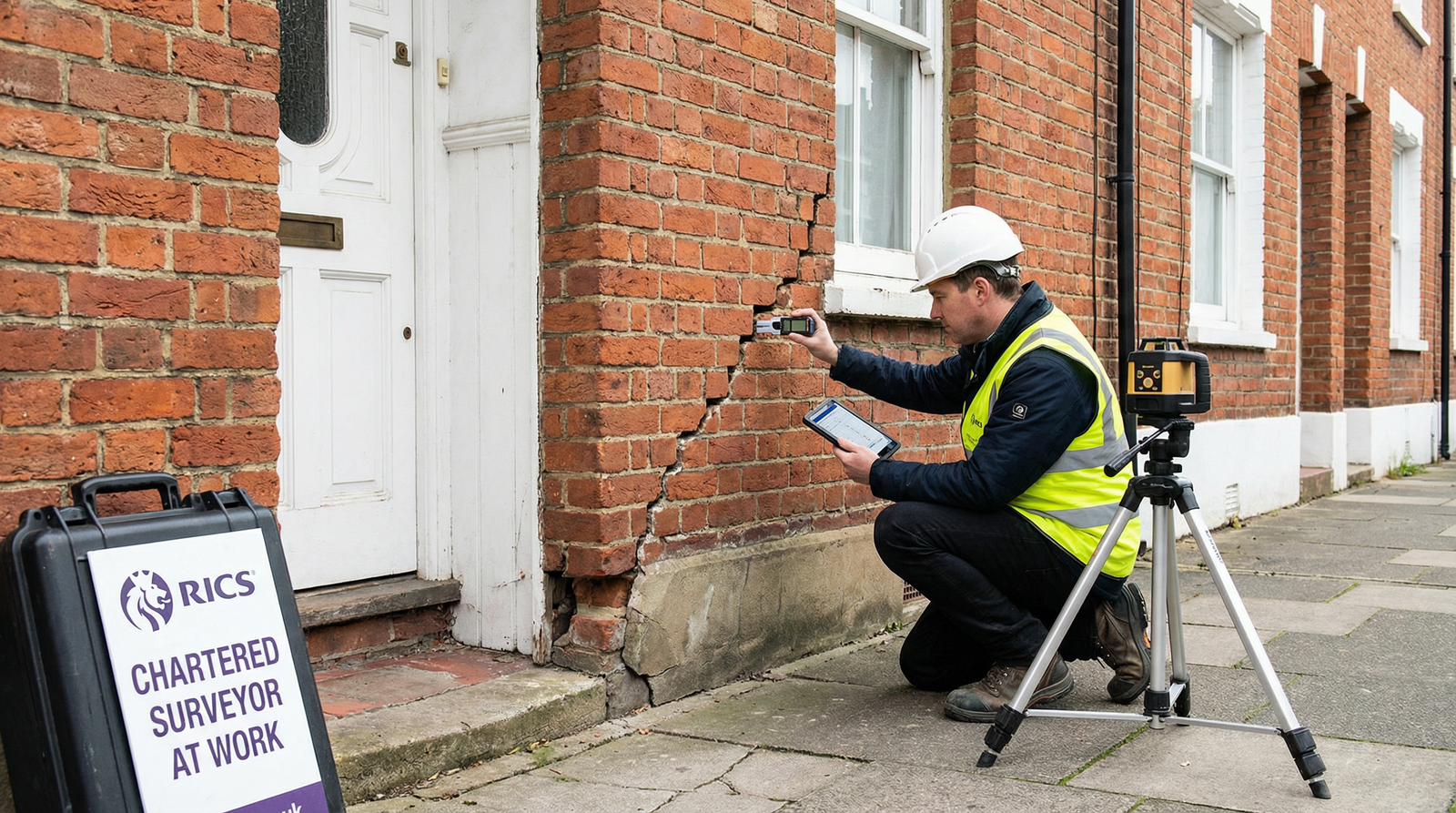
Subsidence is one of the most serious structural issues affecting London properties, yet it's also one of the most misunderstood. As RICS chartered building surveyors who investigate subsidence claims regularly, we find that many cracks homeowners believe indicate subsidence are actually harmless settlement or thermal movement. However, genuine subsidence requires prompt professional assessment and appropriate treatment.
This comprehensive guide explains how to identify true subsidence, what causes it in London's unique geological conditions, treatment options and costs, and crucial insurance considerations.
What Is Subsidence?
Subsidence is the downward movement of the ground beneath a building's foundations, causing the structure to sink and resulting in characteristic cracking patterns. It differs from settlement (normal bedding-in of new buildings) and heave (upward ground movement).
London's Clay Soil and Subsidence Risk
Much of London sits on London Clay, a shrinkable clay soil particularly susceptible to volume changes. This clay expands when wet and contracts when dry, creating perfect conditions for subsidence during prolonged dry periods.
High-risk areas in London include:
- Properties on clay soils with large trees nearby
- Areas with shallow foundations (pre-1900 properties)
- Properties near water sources that have been removed or diverted
- Areas affected by historic mining or excavation
Identifying Subsidence: Key Warning Signs
During building surveys, RICS chartered surveyors look for specific patterns that distinguish subsidence from normal cracking.
Classic Subsidence Crack Patterns
- Diagonal cracks: Typically tapering (wider at top than bottom)
- Location: Often near windows, doors, and building corners
- Width: Typically exceeding 3mm (wider than £1 coin)
- Stepped cracking: Following brick courses
- External manifestation: Cracks visible on external walls
- Progressive nature: Worsening over time rather than static
What Subsidence Is NOT
Many homeowners confuse normal cracking with subsidence:
- Hairline cracks: Usually thermal movement or plaster shrinkage
- Horizontal cracks: Rarely indicate subsidence
- Cracks at plaster joints: Normal plasterwork movement
- Isolated cracks: Subsidence typically shows patterns across multiple areas
Common Causes of Subsidence in London
Tree Root Activity
The single most common cause of subsidence in London. Large trees extract significant moisture from clay soils, causing shrinkage. Trees to watch for:
- High water demand: Oak, willow, poplar, elm, plane
- Moderate risk: Ash, lime, cherry, birch
- Lower risk: Beech, magnolia, apple
Safe distances: As a rule of thumb, trees should be at least their mature height away from properties on clay soils.
Leaking Drains
Defective drains can wash away or soften soil beneath foundations. We routinely recommend drain surveys when subsidence is suspected.
Inadequate Foundations
Many Victorian and Georgian properties have shallow foundations (2-3 feet deep), inadequate for London's clay soils. These properties are particularly vulnerable during drought periods.
Professional Investigation Process
Suspected subsidence requires systematic investigation:
Initial Building Survey
RICS Level 3 building surveys include detailed crack analysis, moisture readings, and assessment of likely causes. We examine internal and external walls, floor levels, and building alignment.
Crack Monitoring
For borderline cases, we recommend crack monitoring over 12 months using tell-tales or graduated markers. This determines whether movement is ongoing or historic.
Specialist Investigations
Complex cases may require:
- Structural engineer assessment: Detailed structural analysis
- Trial pits: Excavations to examine foundation depth and condition
- Ground investigation: Boreholes to assess soil conditions
- Drain surveys: CCTV inspection of drainage systems
- Tree surveys: Arboricultural assessment of nearby trees
Subsidence Treatment Options and Costs
Minor Interventions (£2,000-£10,000)
- Tree removal or management: £2,000-£5,000
- Root barriers: £3,000-£8,000
- Drain repairs: £1,000-£5,000
- Improved drainage: £2,000-£6,000
Many subsidence cases stabilize with these less invasive solutions, particularly if tree-related.
Underpinning (£15,000-£100,000+)
Traditional mass concrete underpinning involves excavating beneath existing foundations in stages and filling with concrete to create deeper, more stable foundations.
Typical costs:
- Minor underpinning (small section): £15,000-£30,000
- Moderate underpinning (whole wall): £30,000-£60,000
- Extensive underpinning (entire building): £50,000-£150,000+
Costs depend on access, depth required, ground conditions, and extent of work.
Alternative Solutions
- Piled underpinning: Mini-piles driven to stable strata (£20,000-£80,000+)
- Resin injection: Expanding resin to consolidate soil (£5,000-£20,000)
- Chemical treatment: Specialized soil stabilization techniques
Insurance and Subsidence
Making a Claim
Most buildings insurance policies cover subsidence (with typical £1,000 excess). However, claiming can affect future insurability and premiums.
When to claim:
- Extensive damage requiring major repairs
- Underpinning costs exceed your financial resources
- Progressive movement threatening structural integrity
When NOT to claim:
- Historic movement that has stabilized
- Minor cracking that can be repaired cosmetically
- When less invasive solutions are viable and affordable
Insurance Implications for Buyers
Properties with subsidence history may face:
- Higher insurance premiums (£200-£500+ extra annually)
- Difficulty obtaining insurance from standard providers
- Increased policy excesses (£2,500-£5,000 for subsidence)
- Exclusion clauses for specific causes (e.g., particular trees)
Buying Properties with Subsidence
Questions to Ask
- What caused the subsidence?
- When was it identified and treated?
- What treatment was carried out?
- Has movement stopped or is monitoring ongoing?
- What insurance/warranty covers the repairs?
- Can I see engineer's reports and certificates?
Price Negotiations
Properties with subsidence history typically sell for 10-25% below similar unaffected properties. Use this knowledge to negotiate, considering:
- Extent and cause of subsidence
- Quality and warranty period of repairs
- Ongoing monitoring requirements
- Insurance implications
- Future resale challenges
Frequently Asked Questions
How do I know if my house has subsidence?
Look for diagonal cracks wider than 3mm, particularly around doors and windows, that taper (wider at top). Cracks should be visible externally and show signs of recent movement. However, most cracks are NOT subsidence – commission a RICS Level 3 building survey for professional assessment before panicking. Many supposed subsidence cases are actually harmless thermal movement or settlement.
Does subsidence always require underpinning?
No. Many subsidence cases stabilize with less invasive solutions like tree removal, root barriers, or drain repairs costing £2,000-£10,000. Underpinning is only necessary when movement continues despite addressing the cause, or when foundations are inadequate. Approximately 40-50% of subsidence cases resolve without underpinning. Always explore alternatives before committing to expensive underpinning.
Should I buy a house that's been underpinned?
Possibly, with appropriate price reduction and professional assessment. Well-executed underpinning with structural engineer certification and 10+ year warranty can make properties perfectly safe. However, expect to pay 10-20% less than similar properties, face higher insurance costs, and potentially find resale more difficult. Commission detailed RICS survey and structural engineer review before purchasing any underpinned property.
Conclusion
Subsidence is serious but manageable. Most cases stabilize with appropriate treatment, and many supposed subsidence issues are actually harmless cracking. The key is professional assessment from RICS chartered surveyors who can distinguish genuine subsidence from normal building movement and recommend appropriate solutions.
If you suspect subsidence or are buying a property with subsidence history, contact our team of experienced RICS surveyors for professional assessment.
About the Author: This subsidence guide was authored by London Home Surveys' structural investigation team, RICS chartered surveyors with specialist qualifications in subsidence assessment who have investigated over 500 subsidence cases across London, working alongside structural engineers and insurance companies to distinguish genuine subsidence from harmless settlement.